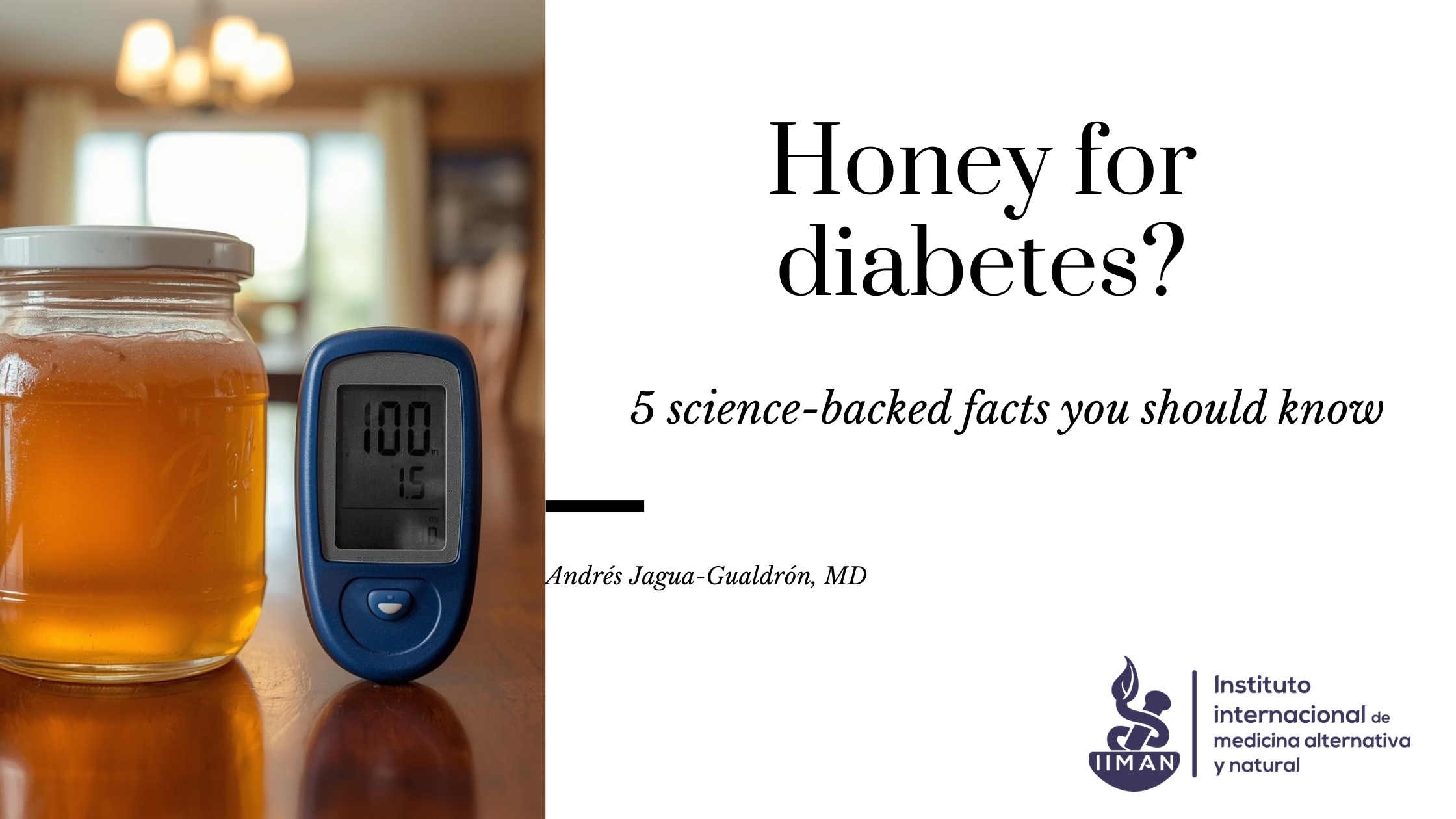
Honey for Diabetes: Is It Safe? 5 Science-Backed Facts You Should Know
The relationship between honey for diabetes has long been a topic of debate in both clinical practice and among patients. While some consider honey to be just another form of sugar that should be avoided, others promote it as a natural alternative with potential metabolic benefits. This has led to confusion and decisions often based on perception rather than scientific evidence.
Beyond its sugar content, honey is a complex substance containing bioactive compounds that may influence key mechanisms involved in diabetes, including inflammation, oxidative stress, and insulin resistance. This raises an important clinical question: could honey behave differently from refined sugar in individuals with diabetes?
In this article, we explore five key scientific findings that help clarify the role of honey in diabetes and its potential use within an integrative medical approach.
Honey for diabetes: why is it so controversial?
The relationship between honey for diabetes is controversial mainly due to the apparent contradiction between its composition and its biological effects. On one hand, honey is rich in simple sugars, which suggests it should behave similarly to refined sugar. On the other hand, scientific evidence indicates that its metabolic impact may differ due to its complex bioactive composition.
Is honey the same as sugar in diabetes?
From a basic nutritional standpoint, both honey and sugar provide simple carbohydrates. However, reducing honey to “just sugar” is an oversimplification. Unlike refined sugar, honey contains a mixture of fructose and glucose in varying proportions, along with enzymes, minerals, and phenolic compounds.
These components influence not only its glycemic index but also its absorption and metabolism. Clinical studies have shown that, compared to glucose or sucrose, honey may produce a lower glycemic response in diabetic patients, suggesting that not all sugars behave the same physiologically.
Diabetes pathophysiology and glucose metabolism
Diabetes mellitus is a complex metabolic disorder characterized by chronic hyperglycemia, but its underlying mechanisms extend far beyond glucose levels. Insulin resistance, chronic inflammation, oxidative stress, and mitochondrial dysfunction play central roles in its development and progression.
In this context, any dietary component should be evaluated not only for its immediate effect on blood glucose but also for its impact on these underlying mechanisms. This broader perspective helps explain why foods with sugar content may have different metabolic effects depending on their overall composition.
What current scientific evidence shows
Recent research in apitherapy suggests that honey has antioxidant, anti-inflammatory, and potentially insulin-modulating properties, largely due to its flavonoids and phenolic acids. Clinical trials in diabetic patients have shown that honey consumption does not produce significant negative effects on glycemic control and may even improve metabolic parameters such as lipid profiles.
However, these findings must be interpreted with caution. The evidence is still heterogeneous and influenced by factors such as dosage, type of honey, and patient characteristics. Therefore, honey should not be considered a therapeutic substitute, but rather a potential component within a supervised integrative approach.
Finding 1: Honey for diabetes and its impact on blood sugar
One of the most important aspects in the discussion of honey for diabetes is its effect on blood glucose levels. Traditionally, honey has been assumed to behave similarly to refined sugar due to its simple sugar content. However, scientific evidence suggests that its metabolic behavior may differ.
Glycemic index of honey vs sugar
The glycemic index (GI) is a useful tool to assess how quickly a food raises blood glucose levels. In general, honey has a moderate glycemic index, lower than pure glucose and, in many cases, lower than sucrose.
This difference can be explained by several factors. First, honey contains a higher proportion of fructose, which is metabolized differently from glucose. Second, its composition includes bioactive compounds that may influence intestinal absorption and metabolic responses.
It is important to note, however, that the glycemic index of honey is not uniform and can vary significantly depending on its botanical origin, processing, and purity.
Glycemic response in diabetic patients
Beyond the glycemic index, clinical studies have directly evaluated the glycemic response following honey consumption in diabetic patients. Several trials have shown that honey may produce lower increases in blood glucose compared to glucose or sucrose, particularly when consumed in moderate amounts.
Additionally, some studies suggest that the insulin response may also differ, which could have implications for long-term metabolic control. These findings support the idea that honey should not be viewed simply as “another sugar,” but rather as a food with distinct metabolic properties.
However, this does not mean that honey is harmless. Its consumption still leads to an increase in blood glucose levels and must be carefully managed, especially in individuals with diabetes. The key factors are dosage, clinical context, and individualized nutritional planning.
Finding 2: Honey for diabetes and metabolic control
Beyond its immediate effect on blood glucose, honey for diabetes has also been studied in terms of long-term metabolic control, including markers such as HbA1c and lipid profile.
Effects on HbA1c
HbA1c is a key indicator of long-term glycemic control. Some clinical studies suggest that moderate honey consumption does not significantly worsen this parameter and may even show slight improvements in certain contexts.
However, results are not consistent and depend on dosage and patient characteristics.
Impact on lipid profile
Some studies report reductions in total cholesterol and LDL, along with increases in HDL following honey consumption. These effects may be linked to its antioxidant properties.
Finding 3: Honey for diabetes and anti-inflammatory effects
Chronic low-grade inflammation is a core component of diabetes, making honey for diabetes relevant due to its potential anti-inflammatory properties.
Chronic inflammation in diabetes
Type 2 diabetes is associated with elevated inflammatory markers such as TNF-α and IL-6, contributing to insulin resistance and vascular damage.
Bioactive compounds in honey
Honey contains flavonoids and phenolic acids that may inhibit inflammatory pathways such as NF-κB, reducing inflammation and oxidative stress.
Finding 4: Honey for diabetes and insulin resistance
Insulin resistance is central to type 2 diabetes, and honey for diabetes has been explored in this context.
Molecular mechanisms
Some evidence suggests honey compounds may influence insulin signaling pathways, potentially improving glucose utilization at the cellular level.
Clinical implications
While promising, clinical evidence is still limited, and honey cannot be considered a treatment for insulin resistance.
Finding 5: Honey for diabetes: quality, type, and dosage matter
The variability of honey is a critical factor in understanding honey for diabetes.
Differences between honey types
Botanical origin and processing significantly influence honey composition and biological effects.
Risks of adulterated honey
Adulterated honey may contain added sugars, eliminating potential benefits and increasing metabolic risk
Honey for diabetes: can patients safely consume it?
Current evidence suggests that honey for diabetes is not absolutely contraindicated, and that its consumption may be safe when properly managed. Rather than adopting a restrictive approach, clinical studies indicate that honey can be incorporated into a structured nutritional plan under appropriate conditions.
However, its use should be guided by clinical criteria, metabolic monitoring, and patient education. This applies not only to patients, but also to beekeepers and apitherapists interested in evaluating its safety in practice.
Individualized clinical approach
The use of honey in patients with diabetes must be individualized, taking into account baseline glycemic control, pharmacological treatment, type of diabetes, and overall metabolic status.
A practical way to assess safety is through direct monitoring:
2-hour postprandial glucose measurement, to evaluate immediate impact
HbA1c assessment after 2 months, to evaluate long-term effects
This allows for data-driven decisions tailored to each patient.
Regarding dosage, clinical studies suggest that up to 75 grams of honey per day may be safe in certain contexts, without significant deterioration in glycemic control. However, this should not be interpreted as a universal recommendation.
From a practical perspective, the best dosing strategy is to distribute honey intake throughout the day, avoiding large glycemic loads in a single serving and promoting more stable metabolic responses.
Apitherapy as integrative medicine
Within integrative medicine, honey can be considered not only as a food but as a complementary therapeutic resource. Apitherapy focuses on the use of bee products based on their biological properties.
In this context, honey may contribute to strategies aimed at modulating inflammation, oxidative stress, and metabolic function. However, it is essential to emphasize that it does not replace conventional medical treatment, but rather complements it.
The role of healthcare professionals and apitherapists is crucial to ensure safe, evidence-based, and individualized use, including proper guidance and follow-up.
Conclusion on honey for diabetes
The relationship between honey for diabetes is far more complex than traditionally assumed. The simplistic view that equates honey with refined sugar does not accurately reflect current scientific evidence or its biological complexity.
What current evidence supports
Current evidence indicates that honey has distinct metabolic properties, including antioxidant and anti-inflammatory effects, as well as a potentially different glycemic response compared to refined sugar. Controlled consumption has not shown significant adverse effects on glycemic control and may even improve certain metabolic parameters.
This does not mean that honey is risk-free. Its sugar content remains relevant, and its use must be carefully managed. However, there is also no strong evidence supporting its complete exclusion when used appropriately.
Future research directions
Despite promising findings, significant gaps remain. More robust, standardized clinical trials are needed to better understand the effects of different types of honey, dosages, and patient populations.
Further research into molecular mechanisms is also essential to clarify how honey may influence insulin resistance, inflammation, and metabolic regulation.
Advancing this field will not only clarify the clinical role of honey but also strengthen the scientific foundation of apitherapy within integrative medicine.
References
- Jagua-Gualdrón A, García-Reyes NA, Fernández-Bernal RE. Apitherapy for diabetes mellitus: mechanisms and clinical implications. J Complement Integr Med. 2025;22(2):228–236. doi:10.1515/jcim-2024-0367.
- Erejuwa OO, Sulaiman SA, Wahab MSA. Honey: a novel antioxidant. Molecules. 2012;17(4):4400–4423.
- Erejuwa OO, Sulaiman SA, Wahab MSA, Sirajudeen KNS, Salleh MS, Gurtu S. Glibenclamide or metformin combined with honey improves glycemic control in streptozotocin-induced diabetic rats. Int J Biol Sci. 2011;7(2):244–252.
- Bahrami M, Ataie-Jafari A, Hosseini S, Foruzanfar MH, Rahmani M, Pajouhi M. Effects of natural honey consumption in diabetic patients: an 8-week randomized clinical trial. Int J Food Sci Nutr. 2009;60(7):618–626.
- Abdulrhman M, El-Hefnawy M, Hussein R, El-Goud AA. The glycemic and peak incremental indices of honey, sucrose and glucose in patients with type 1 diabetes mellitus: effects on C-peptide level. Acta Diabetol. 2011;48(2):89–94.
- Yaghoobi N, Al-Waili N, Ghayour-Mobarhan M, Parizadeh SMR, Abasalti Z, Yaghoobi Z, et al. Natural honey and cardiovascular risk factors: effects on blood glucose, cholesterol, triacylglycerol, CRP, and body weight compared with sucrose. ScientificWorldJournal. 2008;8:463–469.
- Bogdanov S, Jurendic T, Sieber R, Gallmann P. Honey for nutrition and health: a review. J Am Coll Nutr. 2008;27(6):677–689.
- Alvarez-Suarez JM, Tulipani S, Díaz D, Estevez Y, Romandini S, Giampieri F, et al. Antioxidant and antimicrobial capacity of several monofloral honeys. Food Chem Toxicol. 2010;48(8-9):2490–2499.
- Estevinho L, Pereira AP, Moreira L, Dias LG, Pereira E. Antioxidant and antimicrobial effects of phenolic compounds of honey. Food Chem Toxicol. 2008;46(12):3774–3779.
- Ajibola A, Idowu GO, Amballi AA, Oyefuga OH, Iquot IS. Improvement of hematological parameters in diabetic rats treated with honey. Afr J Med Med Sci. 2012;41(2):123–127.
About the Author
Dr. Andrés Jagua-Gualdrón
Physician – Apitherapy Specialist
Director, International Institute of Alternative and Natural Medicine (IIMAN)
Dr. Andrés Jagua-Gualdrón is a physician and apitherapy specialist with extensive clinical and scientific experience in the therapeutic use of bee products. He serves as Director of the International Institute of Alternative and Natural Medicine (IIMAN), where he leads research and professional training initiatives focused on evidence-based natural therapies.
He is also a scientific communicator and international lecturer, recognized for his work in promoting apitherapy as a complementary therapeutic approach supported by clinical and biomedical research.
Author